
Project Lazy Newsletter | Issue 3 | 22nd July 2026
Hello everyone,
We hope you have been doing well!
You are receiving this email because you expressed interest in staying connected with Project Lazy. We are excited to share what we have been working on, what we have learned, and a few things we hope you will enjoy exploring.
We will send updates like this every so often, but if at any point, you’d prefer not to receive them, just click unsubscribe at the bottom of this email.
And to everyone joining us for the first time—welcome! We are delighted to have you as part of our growing community.
📌Recent Highlights📌
🖋️ Creative Writing Workshop Exploring Laziness
On 22 April, we hosted a creative writing workshop led by writer Nicolas Sayers and Professor Katrien Devolder. Participants used creative writing and storytelling to explore and share their own experiences and ideas related to laziness and productivity.
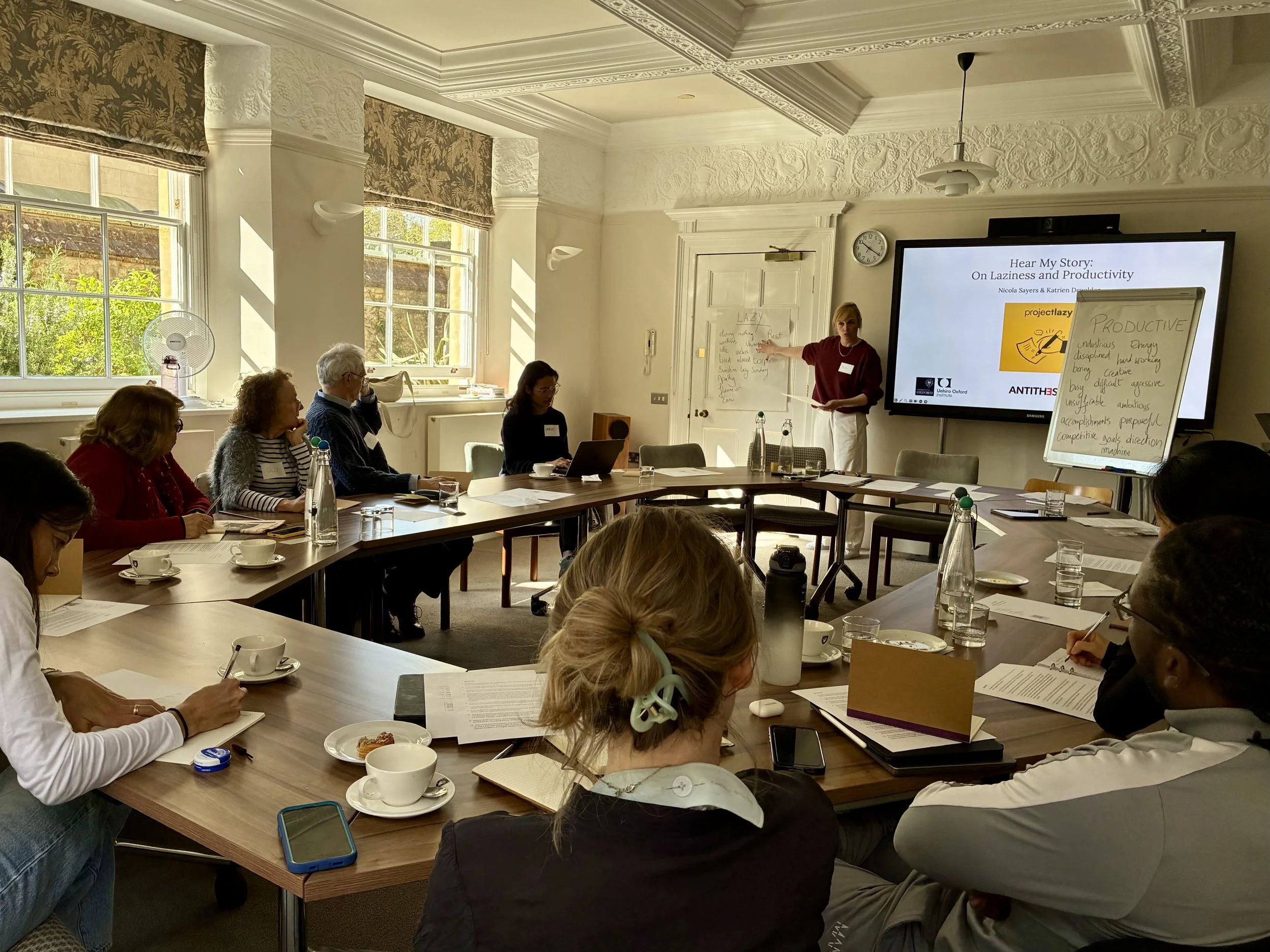
“Since the workshop, I have found myself constantly thinking or challenging held beliefs on laziness and productivity.”- Workshop participant
- Workshop participant
Read our blog for workshop highlights.
🎉 Grant Update
We are thrilled to have progressed to the second stage of the Leverhulme grant application! If successful, the funding would support further research and engagement initiatives.
🤝 Working with communities
The Project Lazy team wants to learn from people's lived experiences and work with communities to explore how ideas about laziness and productivity play a role in everyday life.
We are looking to collaborate with charities, community organisations, and local groups to include a wide range of voices and perspectives.
If you know of a group that might be interested in working with us, we'd love to hear from you! Fill this quick form to enter their details.
If you are new here...
Here are a few great places to start exploring Project Lazy:
🌐 Visit our website www.projectlazy.co.uk to learn more about the project.
📖 Read this brief article on laziness by Professor Katrien Devolder- Why being ‘lazy’ at work might actually be a good thing
🎧 Listen to an interview with Prof. Devolder for the Academic Imperfectionist podcast.
📰 Browse previous issues of our newsletter.
📜 An interesting historical fact related to laziness
In the final decades of the Ottoman Empire (1300-1922), laziness was treated as a political concern. As the empire sought to modernise and compete with industrial Europe, hard work, discipline, and productivity were promoted as signs of a strong, ‘civilised’ nation. In contrast, wasting time and perceived laziness could be punished through salary reductions, compulsory transfers, and even dismissal from public office.
This thinking continued into the early Turkish Republic. In 1934, Ottoman classical music was briefly banned from national radio because it was associated with the old empire and believed to encourage inactiveness and laziness.
This gives us a glimpse into how ideas about laziness can be shaped by politics, culture, and changing ideas about what makes someone a valued member of society. Rather than simply describing individual behaviour, laziness often reflects the values and priorities of the societies in which it is defined.
Some things we are reading and watching
🎬 Very Happy Alexander (1968)
This French comedy follows Alexander, who decides to stop working after years of living under his wife's strict control. But his apparent idleness hides a surprising amount of preparation. He builds an elaborate pulley system to bring himself food and wine without leaving his bed and even trains his dog to run errands for him. This movie is a delightful reminder that sometimes doing nothing takes a lot of work.
📚 Oblomov (1859), by Ivan Goncharov
Set in nineteenth-century Russia, this classic novel follows an aristocrat whose extraordinary reluctance to act critiques a privileged class insulated from work and responsibility. Yet Oblomov is no simple caricature of laziness: he is a perceptive, deeply reflective thinker whose observations on life and purpose remain strikingly relevant today. The novel asks a timeless question-where is the line between thoughtful contemplation and destructive inertia?
💰 The FIRE Movement
The FIRE (Financially Independent, Retire Early) movement has attracted a growing global following by encouraging people to save and invest aggressively often by living well below their means to achieve financial independence, early retirement and greater freedom later in life.
Like Alexandre in Very Happy Alexander, FIRE followers devote considerable effort today in pursuit of a future with less work. And like Oblomov, the movement invites us to reflect on the value of freedom from work. Is it for idleness, contemplation, or simply the chance to live differently?
Read about the FIRE movement here: We had packed lunches every day for 10 years and retired at 40
📩 Stay Connected
We’d love to hear from you—whether it’s a quote, a book, a film, or just a thought—that resonates with the ideas behind Project Lazy.
Your voices and insights will continue to shape this work in meaningful ways!
That's all for Issue 3 of the Project Lazy newsletter. Thanks for reading! We hope you found something that sparked curiosity, reflection, or even a new way of thinking about laziness.
Until next time!