
Being Judged as Lazy: What Participants Shared in Our First Community Workshop
Project Lazy is an open and evolving research initiative examining what we mean by ‘lazy’ and reflecting on the social and ethical norms that shape our thinking about laziness. We invite everyone to contribute their insights and experiences as the project develops. You can find more information on the Project Lazy website and subscribe to our newsletter to receive updates.
About the Workshop
Project Lazy held their first community engagement workshop on 25 June 2025. The workshop was hosted online and brought together twenty-three people from a wide range of backgrounds, including people with lived experience of disability, chronic illness, racial or ethnic discrimination, socioeconomic disadvantage, mental health challenges, and neurodivergence (e.g. autism and ADHD).
The aim of the workshop was to explore how judgements about laziness affect people's lives and what sorts of approcahes might reduce the harms associated with these judgments.
Through interactive activities and small-group discussions, participants reflected on times when they had been labelled lazy, considered themselves to be lazy, or witnessed others being judged as lazy.
Experiences of Laziness Judgments
Participants described experiences across many areas of life, including family relationships, schools, workplaces, healthcare settings, and wider society.
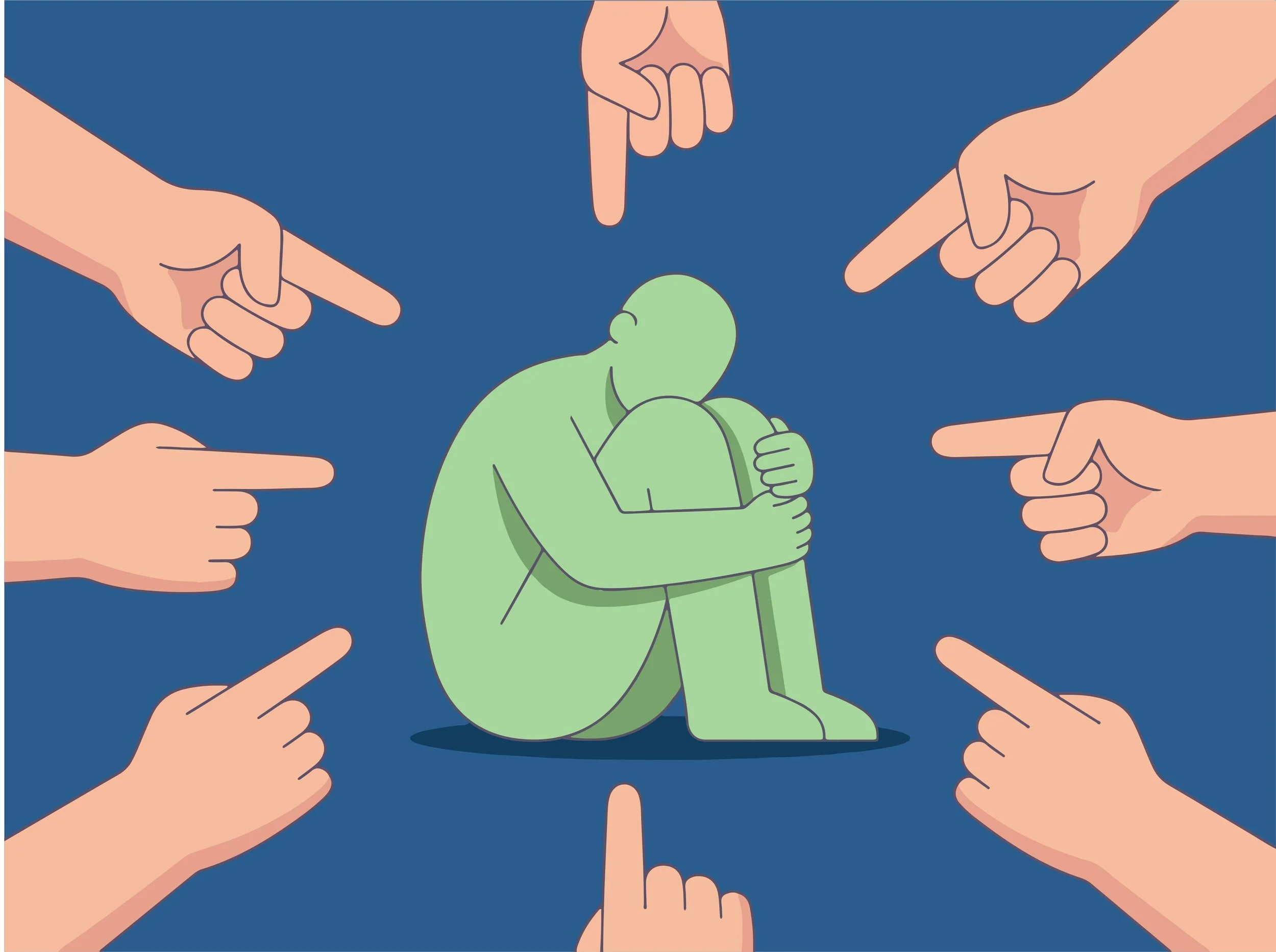
Source: Unsplash/ Maulana Ahmad
Invisible Conditions Mistaken for Laziness
Many participants shared experiences of being perceived as lazy while living with chronic illness, disability, neurodivergence, mental health conditions, or other invisible challenges.
One participant explained how autism affected their ability to work full-time:
“I am autistic, for context. I really struggle with full-time work. I have been called lazy because I can’t hold down a full-time job, because it’s not something my brain can manage...Because I am not able to do that, people often assume that I am choosing not to because I don’t want to. In reality, it’s about the way my brain works. I am simply not able to do that in the same way that other people can.”
-Participant
Another participant living with a respiratory condition described how exhaustion is often mistaken for laziness:
“I am a respiratory patient. So I have different episodes in a year and my cough is still there like for six weeks and eight weeks and I cough a lot...I have no energy left in the evenings to do any kind of work like even just picking the kids from school. And I don't want to do any work not because I don't want to.It's because I am tired. I am very, very tired. I want to go to bed.”
- Participant
These experiences highlighted how resting, doing less, or slowing down is often judged without recognising that, for some people, managing everyday life can require considerable effort that may not be visible to others.
Cultural Expectations and Assumptions about Productivity
Participants also reflected on the wider social and cultural assumptions that shape ideas about laziness.
One participant described how stereotypes surrounding the Greek financial crisis continue to affect perceptions of Greek people:
“I have overheard people discussing that we struggled financially in Greece because we're lazy and we don't work enough...But you know in Greece, an average work week would be about 50 to 55 hours”
- Participant
Others reflected on expectations around hard work within their families and cultural communities. One participant reflected that, within her South Asian family, visible hours worked were valued over the nature or intensity of the work itself:
“I was a criminal law prosecutor, and I used to work quite long hours in what I did. But even from my own mum, I used to or still do get certain comments about laziness...I was compared with my mum and dad who had a business and my mum would work 16 hours a day in her shop and therefore compare me because I only did 10 hours in a busy Criminal Court.”
- Participant
These discussions revealed how cultural expectations and norms of productivity can lead to unfair judgements of individuals and even entire communities.
Childhood Experiences and Internalised Judgements

Source: Unsplash/ Caleb Woods
Many participants described how being repeatedly labelled 'lazy' throughout their lives—particularly during childhood and by family members—had shaped the way they saw themselves as adults.
One participant added:
“As a child, I can remember many occasions when my parents would say I was lazy because I simply wanted to relax for a while. When I was in my early teens, I might have been at the gym or busy with other activities, but if I wasn’t doing things immediately and according to their timetable, it would be “lazy, lazy, lazy.” I think that when you hear that repeatedly over the years, you internalise it. As an adult, I almost feel that I am ridiculously hard on myself. I can’t relax because I think to myself, am I lazy?”
- Participant
These conversations revealed that repeated experiences of being labelled lazy can become deeply internalised, shaping how people see themselves and affecting their confidence and self-worth, long after the original comments were made.
The Lasting Emotional Impacts of Judgements about Laziness
Participants consistently spoke about feelings of shame, self-doubt and guilt, as well as burnout and the difficulties resting without feeling they needed to earn it.
One participant reflected:
"I actually feel guilty, you know, is it OK to take a break? Have I earned this? Should I be working more?”
- Participant
For some, being repeatedly labelled lazy during childhood continued to affect them as adults. One participant described feeling driven to overachieve to prove those judgements wrong:
“My dad used to call me lazy all the time as a child and I don't think I was...I was diagnosed with autism and probably have a bit of ADHD. But neurodiversity wasn't really discovered in like the 70s and 80s. So, he was forever calling me kind of lazy and different and all kinds of things and getting the blame for lots of things. So now I have actually got 3 research degrees, which is a bit extreme, a way to prove that I am not lazy or stupid or anything else.”
- Participant
These experiences show how judgments about laziness can have lasting effects on people’s wellbeing, relationship with rest, and sense of self-worth.
Reducing the Harms of Judgments about Laziness
Participants were invited to reflect on what could change to reduce the harms associated with laziness judgments.
Together, participants created a collaborative whiteboard identifying actions at three interconnected levels:
changes participants themselves could make
changes other individuals (e.g. employers, family members) could make
wider societal and structural changes

A collaborative white-board prepared during the workshop.
What can we do ourselves?
Participants reflected on the importance of being kinder to themselves, accepting their own limits, and challenging feelings of guilt or shame around rest. They also talked about letting go of other people’s expectations and questioning the idea that doing less means being lazy.
Participants suggested:
"Accepting myself for who and how I am.”
"learning to unlearn the shame."
"replacing guilt with compassion."
"Accept that we all perform to different levels. There is no need to compete with others 100% of the time."
"Replace lazy with resting and time out."
“I should take it easy on myself and stop putting myself down”
“Must stop describing my own periods of inactiveness as laziness”
What can other people do?
Participants felt that everyday interactions could become much more compassionate if people paused before making assumptions. Rather than judging behaviours at face value, they encouraged others to ask questions, listen, and recognise that they rarely know the full story. They called for more support through education, empathy and curiosity rather than blaming or labelling someone as lazy.
Participants suggested:
"Support rather than blaming or assuming."
"Check they are ok."
"Stop being so judgmental."
"We need to educate ourselves and others around the impact of the 'lazy' label."
"People should be more aware and not judge others so quickly. I think people don't always realise what they are saying and the effects it has."
What can society do?
Participants also challenged the wider social and cultural norms that shape ideas about laziness. They questioned the narrow ideas of productivity that equate worth with visible busyness or long working hours, and instead called for a society that values wellbeing, flexibility and different ways of contributing.
They also emphasised the need for greater awareness of invisible illnesses, neurodivergence and the diversity of people's lives and capacities.
Participants suggested:
"Not about numbers of hours or days worked."
"A forgiving society that prioritises wellbeing and happiness over overachieving and money."
"Society is very quick to point the finger. It needs to learn to be more empathetic to others."
“Do away with the term ‘Lazy’ and accept people are different and have varying outputs.”
“More awareness and understanding of neurodiversity and the challenges we face”
“A society that doesn’t demonise normal behaviour and people who have disabilities.”
What the Participants Said About the Workshop
Participants’ feedback on the workshop was very positive. Many said it encouraged them to reflect on their own judgments about laziness.
One participant reflected:
"It was an interesting time and helped me reflect on my own actions as a parent and how that might affect my child in the future. I particularly felt I became a better mum in those two hours."
-Participant
Another participant highlighted the collaborative nature of the workshop:
"I liked the mixture of interaction, the dedicated time for everyone to speak and explain what their experience is, and the feeding back into the team on the whiteboard with our own ideas and expectations to shape the project."
-Participant
Participants also described leaving the workshop with a stronger sense of connection and community.
How the Workshop is Shaping Project Lazy
The workshop broadened our understanding of the harms associated with laziness judgments and highlighted new questions for future research. Participants’ experiences have helped shape Project Lazy’s focus on understanding these harms and exploring how they might be reduced through both individual and wider societal change.
One example of how the workshop has influenced our work was in September 2025, when Professor Katrien Devolder, lead of Project Lazy, delivered a keynote lecture at the annual European Association of Centres of Medical Ethics (EACME) conference in Zurich. The lecture explored how the pressure to work faster can negatively affect healthcare research and considered when slowing down might lead to more meaningful outcomes.
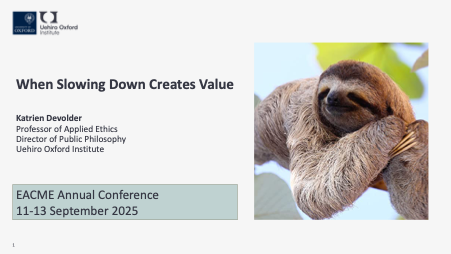
Ideas from the workshop, particularly the collaborative whiteboard, helped shape the discussion. Participants' call for 'support, not blame' and 'changing systems, not individuals' informed the argument that academia has an obligation to support ‘slow’ researchers whose work requires time and deep reflection, rather than ‘simply’ expecting them to work faster and produce more.
The lecture drew significant interest from clinicians and scholars in medical ethics.
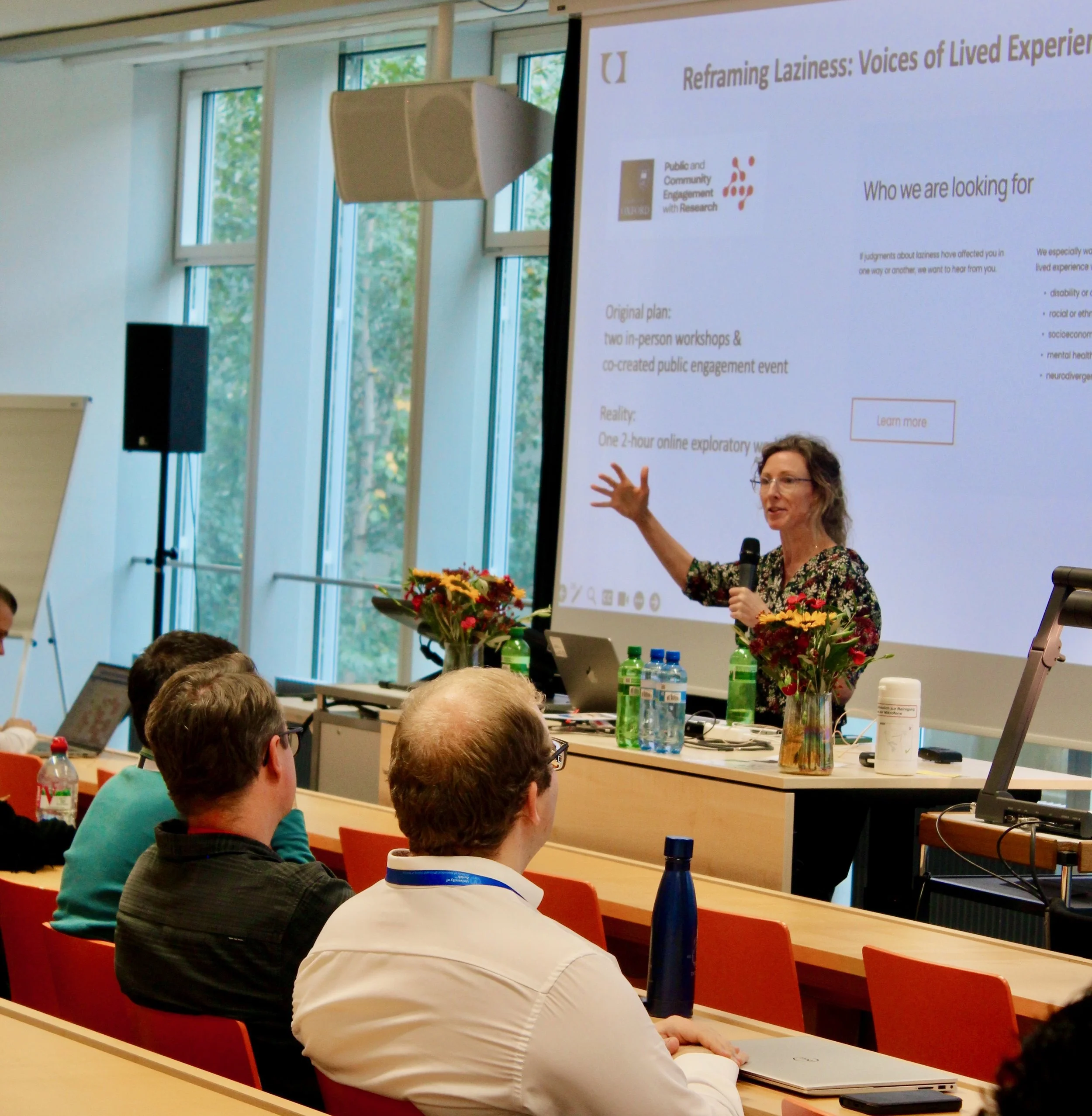
Professor Katrien Devolder, lead of Project Lazy, delivering a keynote lecture at the European Association of Centres of Medical Ethics (EACME) Conference in September 2025.
The workshop was funded by a grant from the University of Oxford’s Public and Community Engagement with Research (PCER) Fund.